
I recently watched both Tangled

The odd thing about these movies, however, is that our family was always warned away from them. Maleficent
I’d like to set the record straight for both of these movies, since I have a feeling I’m not the only one who was told these things once upon a time.

Tangled
Mother knows best
Take it from your mumsy
On your own, you won’t survive!
Sloppy, underdressed
Immature, clumsy
Please, they’ll eat you up alive!
Gullible, naïve
Positively grubby
Ditzy and a bit, well, hmm vague
Plus, I believe
Gettin’ kinda chubby
I’m just saying, ’cause I wuv you
Mother understands
Mother’s here to help you
All I have is one request…Don’t ever ask to leave this tower again.

As Gothel’s narcissism and cruelty become more apparent, Rapunzel realizes that not only is she controlling and abusive, but she’s not even her real mother. Her true mother is grieving her loss and keeping her memory alive in the nearby castle. Tangled, I would argue, is as much about Rapunzel trying to reunite with her parents as it is about her adorable relationship with the lovable scoundrel, Flynn Rider.
Herein lies another point, though: Rapunzel never shows disrespect or contempt towards her presumed mother. Yes, she flees the tower against Gothel’s orders–but Rapunzel is not a child. She is an intelligent adult who suspects things are not as they seem. Having never been allowed the dignity of a logical conversation with Gothel, she seeks out the truth herself. Yet even then, she tries her best to be a dutiful daughter…until she finally realizes she’s in the clutches of an evil witch who has no real love for her at all.

Are there movies that portray parents (real parents, not kidnapping, murderous sorcerers) as buffoons and control freaks? Yes. Are there movies that encourage devil-may-care rebellion from children? Of course. But is Tangled
Tangled does, however, eloquently show the realities of Narcissistic Personality Disorder. Parents should definitely discuss this with their children as they watch Gothel manipulate and abuse Rapunzel, and implore them to watch out for these damaging character traits in themselves and in others.
But how does Gothel’s story connect with Maleficent’s? It connects as a contrast–and a stark one.
Maleficent
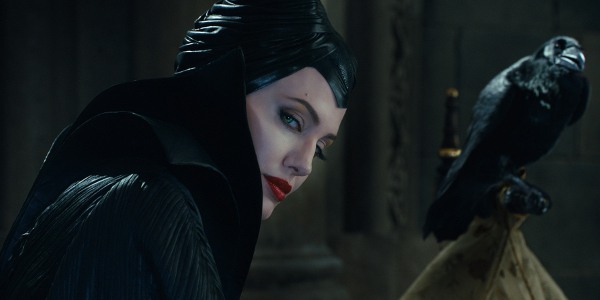
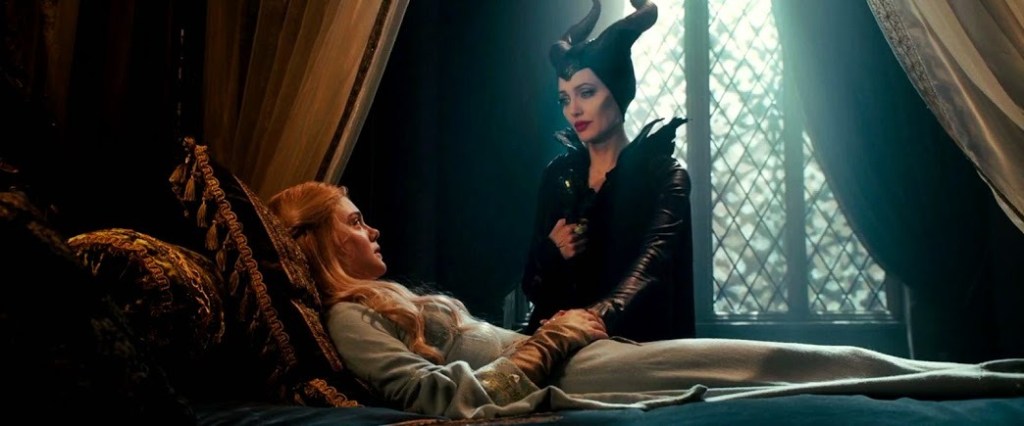
In her agonizing pain, Maleficent has convinced herself that true love can’t possibly exist, which would make Aurora’s doom even more certain. But not even the powerful, embittered Fairy can resist the innocence, goodness, and beauty of the little princess. Before long she finds herself taking care of Aurora from afar; when they finally meet face-to-face, Aurora even assumes, joyfully, that Maleficent must be her Fairy Godmother. As their relationship grows, Aurora awakens a fierce, tender, protective love in Maleficent that can only be described as motherly.

Maleficent
Ah. That is something else entirely.
Gothel did not love Rapunzel for Rapunzel’s sake. She loved Rapunzel’s hair. In order to keep the hair, Gothel isolated, used, guilt-tripped, threatened, and lied to Rapunzel. And in the end, her own greed, self-obsession, and cruelty became her undoing.
But Maleficent loved Aurora. In spite of her anger towards the girl’s father, Maleficent gave herself, heart and soul, to Aurora’s well-being and happiness. She experienced deep remorse and repentance over the curse she laid on Aurora, and did everything in her power to undo it. She offered Aurora everything she had, and her true, self-sacrificial love eventually broke the spell.
Gothel and Maleficent may be the most formidable mother figures in recent Disney history–but as polar opposites, they teach extremely valuable lessons for today’s audiences. One is a textbook example of the insidious narcissism that permeates our society…while the other is a startling picture of the triumph of love over heartache.


 Maribeth Barber Albritton
Leave a reply to liviepearl Cancel reply