This review has been a long time coming. Last year I began hearing rumblings about a new/old sci-fi epic (“new” because it was new to me, “old” because it precedes–and even inspired!–Star Wars). By Christmastide, I was completely intrigued. A grand, sweeping tale full of political intrigue and space travel all revolving around a Chosen One? Yes, please.
But then I picked up a copy of the book at an indie bookstore…and it was like trying to carve a passageway into a mountainside with a fork and a knife. This story is DENSE, and author Frank Herbert, for some inexplicable reason, chose to not only drop his readers into the middle of a vast, politically-unstable universe, but also to head-hop between many, many characters.
(I hate head-hopping. I hate it, hate it, HATE IT. Switching the point-of-view character after a scene break is fine, but to switch between the POVs of two or three different characters in a single scene? It drives me nuts.)
My dear friend Emily, who loves this story, urged me to persevere. I proposed a compromise of sorts: what if I watched the new movie first, just to get some kind of grasp on the story, and then gave the book a second chance?
It was a wise choice. I understand Dune so much more now, and since the film only cover the first third of the novel, I haven’t completely spoiled the rest of the book for myself.
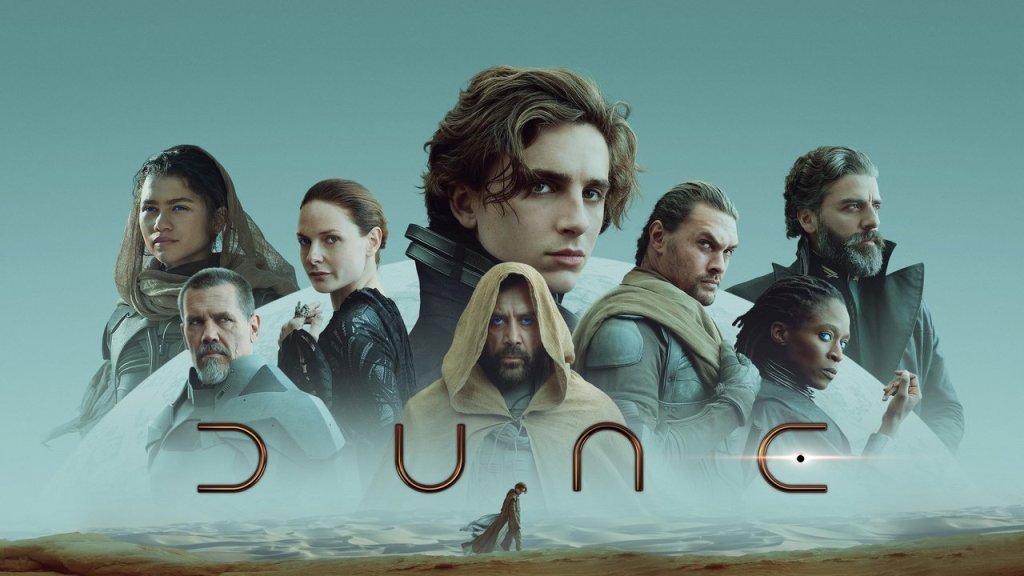
Paul Atreides, a brilliant and gifted young man born into a great destiny beyond his understanding, must travel to the most dangerous planet in the universe to ensure the future of his family and his people. As malevolent forces explode into conflict over the planet’s exclusive supply of the most precious resource in existence, only those who can conquer their own fear will survive.
Google Synopsis
The film Dune is still incredibly dense. In my experience, it requires at least two viewings and a friend who’s a Dune expert before you can really enjoy it. I can’t help considering this a major storytelling flaw. If the average Joe or Jane who hasn’t read the enormous novel still struggles to understand the main conflict, the reasons for spice-harvesting, and the motivations of the Bene Gesserit by the end of the movie, your adaptation has problems.
Of course, I do understand now that the Bene Gesserit (AKA the Space Nuns) have been trying for centuries to genetically engineer a Chosen One who can defeat the evil Empire. I get that the hallucinogenic spice also powers the spaceships…and I’ve wrapped my brain around the rivalry between House Atreides and the Harkonnens. It is a compelling tale. I just needed Emily to explain these things to me, because even she admitted that the movie doesn’t do it well, and I didn’t find that the book explains any of it clearly or quickly.
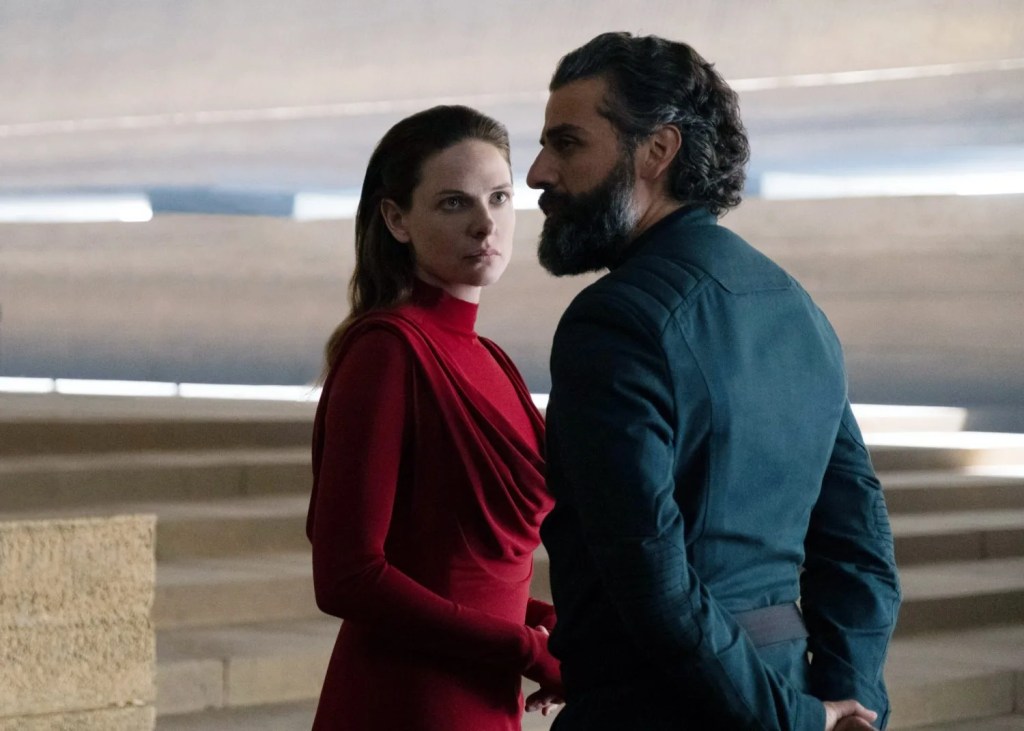
All that said, Dune‘s great strength lies in its excellent cast of characters. Paul Atreides is a courageous, intelligent young hero who genuinely loves his parents–and the fact that his parents love him and each other is equally endearing. Authors, take note: parents can be awesome, and heroes don’t have to be orphans. (I do say this with my tongue firmly in my cheek, as my own heroine, Lindy Tremaine, is an orphan.)
Lady Jessica, Paul’s mother, is played with steely dignity by Rebecca Ferguson. Stellan Skarsgaard plays the cruel, conniving Baron Harkonnen, who’s orchestrated the failure of House Atreides on the desert planet of Arrakis. Oscar Isaac is Paul’s father, the tragic Duke Leto. (Yes, I did snicker when Leto told Paul he always wanted to be a pilot. The Poe Dameron vibes were strong.). Zendaya got the short end of the stick in this movie, since she’s only glimpsed in visions for most of the film and then doesn’t get much character development once Paul finally meets her. Jason Momoa, on the other hand, makes the most of his lovable Duncan Idaho. This was my favorite performance of Momoa’s, hands-down. Aquaman, who?
But really, Timothee Chalamet is the true star of this movie. I saw him in the 2019 adaptation of Little Women, and he was fine…but this movie convinced me of his acting skills. I look forward to seeing what he does in the sequel, especially if it’s as emotionally intense as this one, and if the character of Paul Atreides goes through as much personal growth and trauma as I suspect he will.
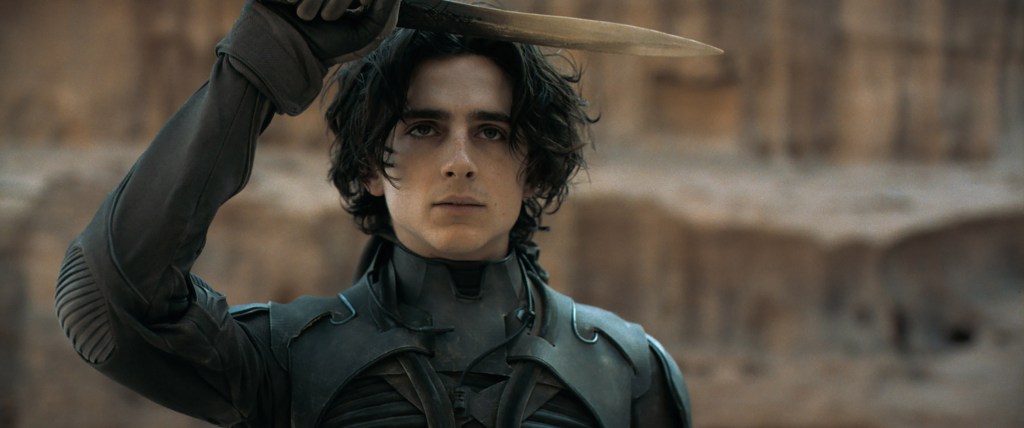
As I said, Dune was one of George Lucas’ primary inspirations for Star Wars, and I do see the similarities. But at the end of the day, I still prefer Star Wars. Not only is it more straightforward, but it’s merry. There’s little to no comic relief in Dune. And though I have a lot of worldview problems with the Force, at least there’s some semblance of destiny and an over-arching, transcendent Power. I don’t get that with Dune, and it makes everything seem much more fatalistic.
I know this is a more critical review than I usually write, and I do apologize for that to all my dear friends who adore this story! Just know that a more critical review does not mean I’m uninterested in the next film, or that I won’t pick up the book again. In fact, now that I’ve finished Piranesi, I intend to give the book another try.
Have you seen or read Dune? What did you think of it? Let me know in the comments!


 Maribeth Barber Albritton
Leave a reply to Alicia Butcher Ehrhardt Cancel reply